
on not knowing
and Hilma af Klint
I am desperate to lose control, to become only vessel. show me I tell the work, and yet I know it is never not showing me. I just have to pay attention.
I am reminded that I do not get to know where any of this is going and that’s the point.
close up - Hilma af Klint | The Swan No. 14 (1915)
deep down, I am good at uncertainty.
I used to hate this about myself.
I remember the day that changed. I had a visceral feeling that what I had previously shamed was meant to be honored. Leave all of that knowing to other people.
Not knowing was the only thing that felt true.
The best art reveals how much I do not know. It leads me to some edge and pushes.
I experienced this standing in front of the work of Hilma af Klint.
Hilma af Klint (1862-1944) was a Swedish painter and mystic. She has one of those stories that I can never seem to get enough of. A classically trained artist, she spent years making landscapes & portraits.
Then, at age 44, her work transformed. She left convention behind.
For most of her life, she spoke to spirits and participated in séances. Her notebooks reveal that at that time, the spirits commissioned her to make a mostly abstract body of work called Paintings for the Temple. Years after her death, this work would upend art history.
-
In 2023, I saw these paintings at the Tate Modern in London. One of the collections on display was her Swan Series. It’s exactly as it sounds, except the series starts off as a painting of two swans and then tumbles into abstraction.
Two of my favorites hung next to each other at the show.
The Swan, No. 1 (1915)
The Swan, No. 8 (1915)
This series reminds me that nothing is as it seems. While I am hurrying things into boxes, they are busy shapeshifting. See with a child’s eyes, it asks. See nothing until you are able to see everything. Look for the life hidden in the form.
The Swan, No. 18 (1915)
close up - The Swan, No. 18 (1915)
Hilma’s abstract work was largely ignored during her lifetime. Instead of acquiescing, she came to believe that her paintings could not be understood by current audiences.
At age 70, she decided to inherit her art to the future. She marked certain paintings with “+x” and left the following instructions:
“All works, which should be opened twenty years after my death, should carry the sign shown above.”
She died at age 81, leaving behind over 1200 works and 26,000 pages of notes.
Tree of Knowledge, No. 3 (1913-15)
Another body of work on display was her Tree of Knowledge series, which I have no real words for. Standing in front of these did something to my body. It felt like a cellular power up - gaining more life.
Tree of Knowledge, No. 1 (1913-15)
In the last and final room at the Tate stood Hilma af Klint’s Ten Largest. Here were mammoth paintings - nearly 8x11 feet tall. The entire series was completed in roughly 40 days.
The paintings depict stages of human life : childhood, youth, adulthood, old age.
The Ten Largest, No.1 (1907) | Childhood
“As an artist, they’re sort of terrifying because they’re so powerful, they’re so perfect, and they look like they were made yesterday.” - Josiah McElheny
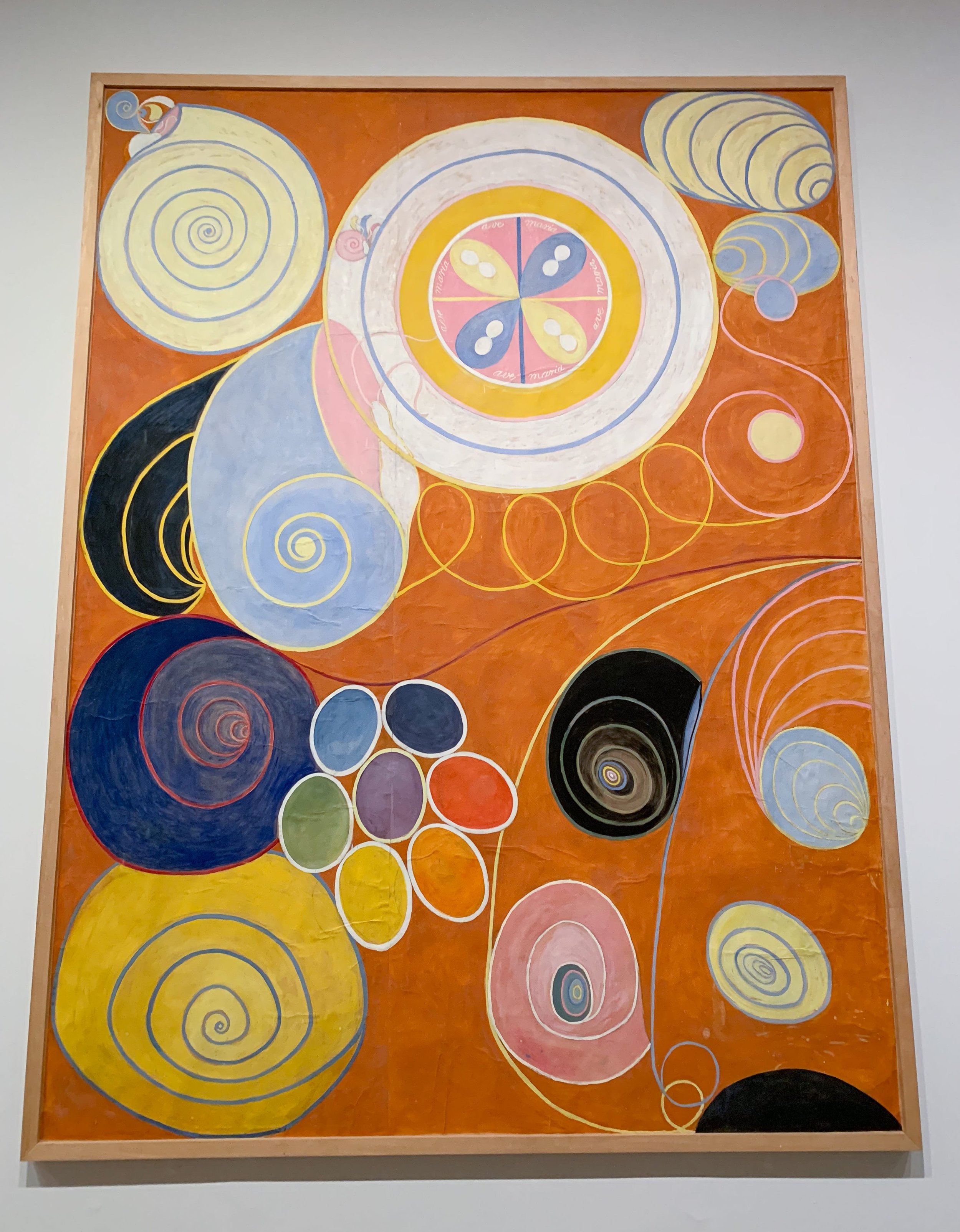
The Ten Largest, No. 3 (1907) | Youth
In that room, I had the great sense that I was with the living. I was witnessing sentience. a nameless, benevolent, playful energy.
No matter that these paintings were over 100 years old. Their aliveness was palpable.
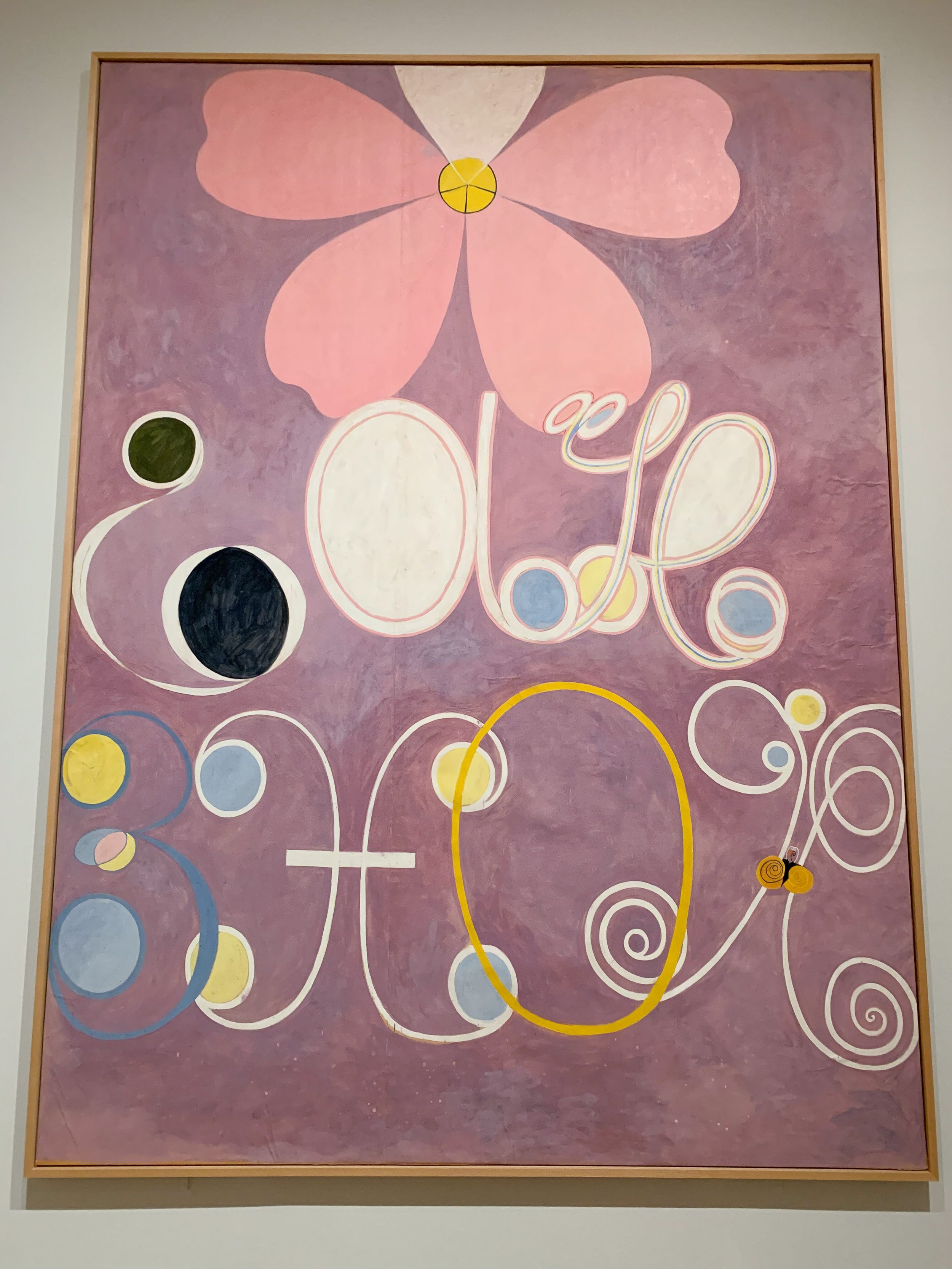
The Ten Largest, No. 5 (1907) | Adulthood
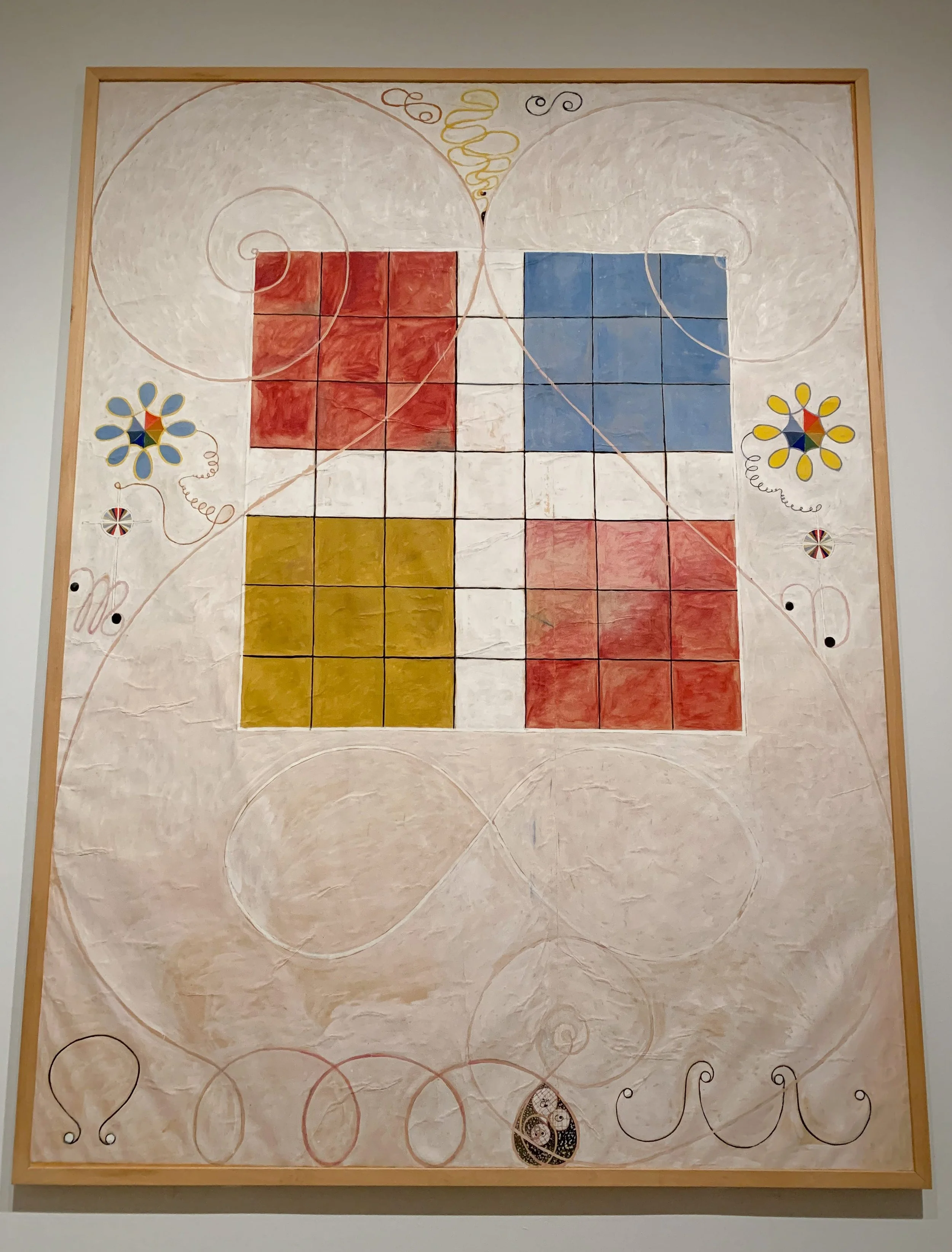
The Ten Largest, No. 10 (1907) | Old Age
Hilma’s work did not resurface in public until nearly 40 years after her death. But when it did, it was like an “asteroid” crashing into the art world. Her arrival disrupted art history’s timeline. It became clear that Hilma was making abstract art years before the supposed fathers of the genre in the West - Kandinsky, Mondrian, etc.
Know less and less, the work beckons.
I am trying to tune my ears to them, these invisible giants.
I must remove the stones lodged in my spine, become more malleable. I am relying on the unseen to guide me, like a fucking ouija board. move here, then there. I cannot see what is being spelled out.
Good, because I am sick of naming things.
The best art changes me. There is nothing quite like that brain breaking feeling, when the world as I know it falls apart and rearranges itself. I can only laugh, cry or grin. All in awe. Total destruction.
I am looking to be broken and rearranged.
References:
Beyond the Visible – Hilma af Klint [great documentary on her story]
Guggenheim Museum: Visionary - On Hilma af Klint and the Spirit of her Time
(Julia Voss and Tracey Bashkoff)
Hilma af Klint: Paintings for the Future by Tracey Bashkoff
Dagens Nyheter: Hilma af Klint’s art could be hidden from public view—in a temple (Julia Voss)